
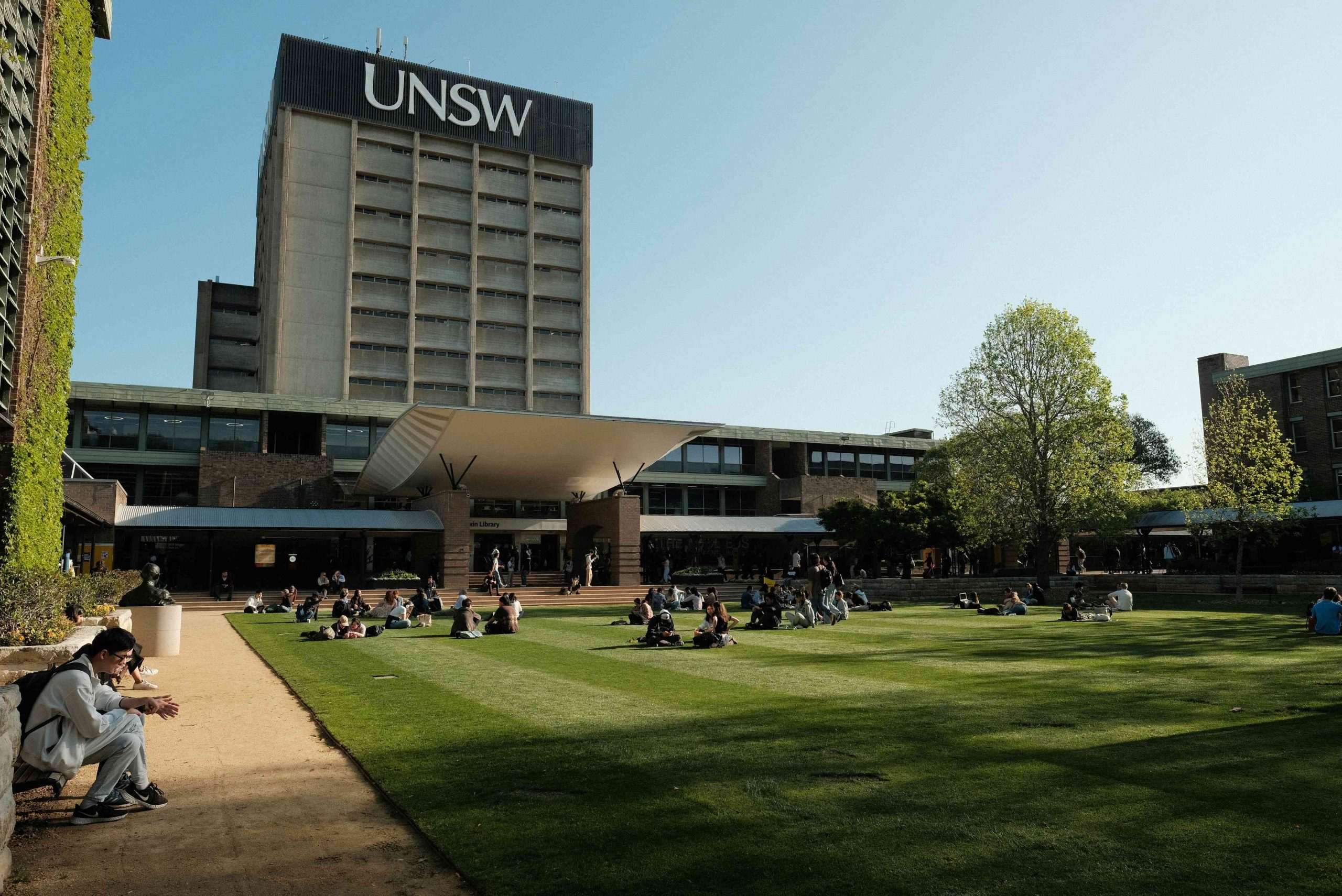
Undergraduate opportunities at UNSW
The ARC Centre of Excellence for the Weather of the 21st Century explores how Australia’s weather is being reshaped by climate change. We offer highly competitive scholarships intended to provide undergraduate students from Australian universities with an introduction to cutting-edge climate science and weather change research.
Students should be in their second, third, or post-honours year and interested in pursuing honours or a postgraduate degree in climate or weather change science. At UNSW, scholarship projects may either run on a full-time basis over the summer or other mid-semester/trimester breaks, or part-time for the equivalent of six weeks fulltime work throughout the academic year. The scholarships are valued at $3,800.
If you have any questions about our undergraduate research scholarships, please contact the Centre’s Associate Director Leadership and Training Melissa Hart.
To apply for an undergraduate research project, please complete this form, which is also available at the bottom of the page.
Processing urban morphology for computer vision applications in city’s weather and climate
Supervisor(s): Dr Negin Nazarian, Dr Jiachen Lu, Dr Sanaa Hobeichi
Description: Complex flow patterns within urban environments are significantly influenced by the diversity of urban layouts but have only been studied from generalizations based on conventional urban geometrical parameters in climate models. However, the inner- and ultra-variability of cities’ layouts including the street orientations, building shapes, and building height distributions challenge the generalization validity. Considering the scope of the study is for global cities, the validation work is better assisted by computer vision techniques that require a strong database of urban morphology. Based on the recent progress in satellite data processing (e.g., OpenStreetMap (OSM) and Microsoft Building Footprints) and building height estimation (World Settlement Footprint (WSF)), the high-resolution urban morphology is ready for this purpose. In this project, the selected student will learn and apply image pre-processing techniques for computer vision applications in weather and climate. The data produced will contribute to enhancing the understanding of urban heterogeneities’ impact on climate models. In this project, the student will be coding and adapting existing scripts.
Experience required: The applicant needs to have programming experience in Python to be successful.
Investigating Extreme Rainfall in Townsville using Reanalysis Data
Supervisor(s): Dr. Leena Khadke and Prof. Jason Evans
Description: Townsville experienced record-breaking rainfall in February and March 2025, with 1,033 mm falling in just the first eight days of February. On March 18–19, the city recorded 301.4 mm in 24 hours which is the heaviest rainfall in 27 years, caused widespread flooding across north Queensland. In the present study, the student will explore the atmospheric and oceanic conditions that contributed to these extreme rainfall events. Using reanalysis data, the student will compare the behaviour of key atmospheric and oceanic variables such as sea surface temperature, outgoing longwave radiation, and atmospheric temperature against its climatology (1995 to 2024). The student will also examine wind patterns and vertical motion to understand how they influenced moisture transport and instability in the atmosphere. By analyzing these events, the study can identify the large-scale weather patterns responsible for the heavy rainfall. The study will help student to understand the mechanism and processes behind the occurrence of such extreme rainfall events.
Experience required: Students need to have experience in Python or MATLAB programming to be considered for this project.
Understanding multi-scale Interactions in Building Humid Heat Environments in Australia
Supervisor(s): Dr Qin Jiang, Prof Steven Sherwood, Dr Marty Singh
Description: Humid heat environments feature high temperatures and humidity at the surface, posing significant risks to public health by reducing the body’s ability to effectively cool itself to a safe core temperature. A synoptic-scale substance is commonly recognized to be responsible for a high dry temperature, but the associated divergence at the low level suppresses the moisture transport, which usually leads to aridity. Conversely, an updraft facilitates the low-level convergence of moisture but undermines heat maintenance capacity within the boundary layer. This dilemma hinders a clear understanding of the physics governing the buildup of humid heat environments. The student will investigate how large-scale synoptic patterns interact with boundary layer thermal dynamics to uncover the physical mechanisms behind humid heat extremes in Australia.
Experience required: Familiarity with Python and a basic understanding of thermal/convective dynamics is required for this project.
Analysis of hail in Australia’s tropics
Supervisor(s): Dr Tim Raupach, Dr Bethan White
Description: Australia’s most hail-prone regions are on the east coast from north of Brisbane to south of Sydney. However, the largest hailstone ever recorded in Australia fell in the sub-tropics, just north of Mackay, and the possibility of hail occurrence extends well into the tropics. In particular, a region around Burketown in Queensland shows as a hotspot of hail probability in radar, satellite, and hail-proxy records. In this project, we will investigate hail occurrence in convection-resolving simulations of the atmosphere around Burketown. The student will gain experience in analysing the output from high-resolution weather models, in atmospheric science, and in scientific programming. The project will increase our understanding of the atmospheric conditions leading to hail formation in the (sub-)tropics, a region in which hail occurrence is not well understood.
Experience required: To complete this project experience with python is essential and experience with analysing large datasets is a plus.